 by
by Table of Contents
- Introduction
- Background and Problem Faced
- The New Initiative by BISE Lahore
- How the Biometric Attendance System Works
- Supporting Technologies and Measures
- Expected Impact and Early Results
- Challenges and Future Considerations
- Conclusion
1. Introduction
The Board of Intermediate and Secondary Education (BISE) Lahore has taken a major step toward ensuring transparency and fairness in public examinations by launching a new initiative aimed at ending identity fraud. Through the introduction of biometric verification and advanced digital tools, the board seeks to eliminate the long-standing issue of impersonation during exams.
This initiative represents a major transformation in how examinations are conducted in Pakistan, moving away from manual, paper-based systems toward a technology-driven model that prioritizes authenticity, fairness, and accountability.
2. Background and Problem Faced
Identity fraud during board exams has been a persistent challenge. In many cases, students would hire someone else to sit in their place, using fake admit cards or altered identification. These incidents not only damaged the credibility of the examination system but also discouraged honest students who relied solely on their hard work.
Traditional verification methods such as photo IDs and manual attendance sheets were often unreliable. Photos could be manipulated, and there was no centralized database to verify the identity of each student in real time. The Lahore Board recognized that to maintain the value of its certificates and protect the merit-based system, a stronger and more modern approach was essential.
3. The New Initiative by BISE Lahore
BISE Lahore introduced a biometric attendance and verification system to prevent impersonation during its examinations. This system was first tested during the supplementary matriculation exams and is now being expanded to cover the intermediate level as well.
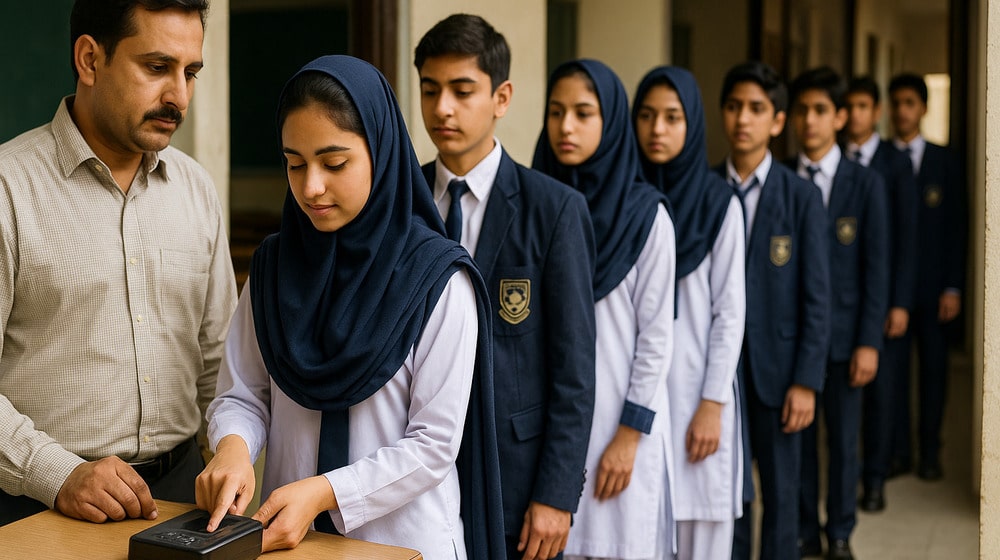
Under the new process, each student’s fingerprint is registered in the board’s database during the exam registration phase. At the examination centre, the student’s fingerprint is scanned before entry, and the system immediately verifies whether it matches the data stored in the system. If the fingerprint matches, the student is allowed to enter; if not, they are denied access and investigated for possible impersonation.
ALSO READ
Intermediate Syllabus Sindh Education Board Updates
To further strengthen the process, roll number slips have been redesigned with unique QR codes, preventing the use of fake or duplicate admit cards. Together, these digital systems provide a double layer of identity protection that significantly reduces opportunities for fraud.
4. How the Biometric Attendance System Works
The biometric system works in several simple but effective steps:
- Students provide their fingerprint data at the time of registration.
- This data is encrypted and stored securely in the board’s database.
- On the day of the examination, biometric scanners are placed at the entrance of each examination centre.
- As students arrive, their fingerprints are scanned and instantly verified.
- Once verified, the system automatically marks their attendance electronically.
This process not only ensures that only registered students can sit for the exam but also minimizes human error in attendance recording. In case of a mismatch or failed verification, the system alerts the examination staff immediately, preventing impersonation on the spot.
5. Supporting Technologies and Measures
The biometric attendance system is supported by several additional technologies designed to enhance transparency and efficiency.
- QR-coded roll number slips store encrypted candidate information, ensuring authenticity.
- Digital attendance monitoring provides real-time updates to the central office.
- CCTV surveillance in examination halls helps maintain discipline and deters cheating.
- Centralized monitoring dashboards allow senior officials to track attendance and verification data from multiple centres simultaneously.
These steps combine to create a modern, secure examination environment where both students and invigilators can focus on fair assessment.
For more details, visit the official website of BISE Lahore.
6. Expected Impact and Early Results
The early implementation of this initiative has shown promising results. During the pilot phase, hundreds of students were verified successfully through the biometric system, and incidents of impersonation dropped to nearly zero.
Teachers, students, and parents have responded positively to the change. Many believe that such reforms will strengthen trust in the examination system and promote a culture of merit. With digital verification and real-time tracking, exam authorities can now identify irregularities faster and take immediate action, ensuring that every student’s achievement is earned honestly.
Additionally, the biometric attendance system has reduced administrative burdens. Automated attendance and digital reporting save time for invigilators and reduce the chances of manual errors or disputes over attendance records.
7. Challenges and Future Considerations
Although the initiative is a major success, it also brings certain challenges that need to be addressed for long-term sustainability.
- Technical reliability: Biometric devices must operate efficiently even in rural areas where electricity or internet connectivity may be unstable.
- Data privacy: The protection of students’ biometric data is critical and requires strong cybersecurity measures.
- Training and awareness: Invigilators and staff need to be properly trained to operate and troubleshoot the system.
- Financial cost: Installing and maintaining biometric scanners across all examination centres requires significant funding.
- Scalability: Expanding the system to cover thousands of examination centres across Punjab will take time and careful coordination.
Despite these challenges, BISE Lahore’s leadership remains optimistic. With consistent improvement and government support, the board plans to extend this system to all major examinations in the coming years.
8. Conclusion
The Lahore Board’s decision to implement biometric verification in its examination system marks a milestone in Pakistan’s educational reform journey. By eliminating identity fraud and ensuring transparent examination processes, the board is paving the way for a more credible and merit-based system.
This initiative not only strengthens institutional integrity but also restores public confidence in education. It ensures that success is based on ability and effort rather than manipulation or deceit.
If effectively expanded and maintained, BISE Lahore’s biometric verification system could serve as a model for examination boards across Pakistan—ushering in a new era of honesty, fairness, and digital transformation in education.